
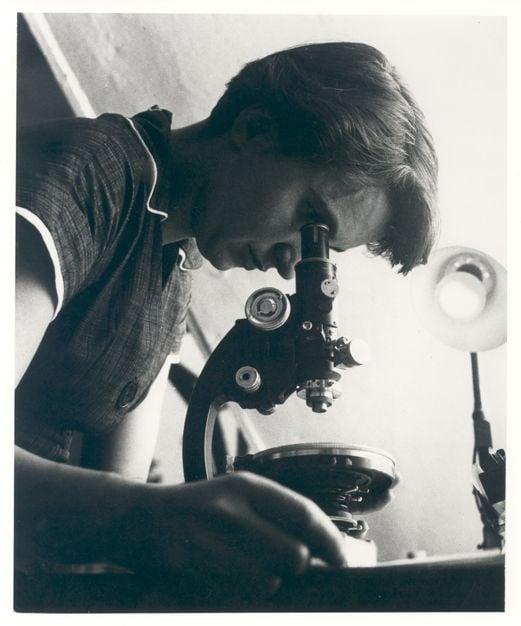
Rosalind Franklin was a major and highly influential scientist from the United Kingdom. During her work at King’s College London, she conducted extensive research on DNA and its structure. At a time when DNA research was limited and often inconclusive, Franklin devoted countless hours to studying and analyzing DNA samples, with the goal of discovering the structure of the famous DNA helix.
As a female scientist, she was often not viewed as equally valuable as her male colleagues. She eventually worked alongside the well-known scientist Maurice Wilkins, with both of them researching the structure of DNA.
Franklin attended Cambridge University and was an exceptionally gifted student with a strong interest in science. Despite her father’s disapproval of her career choice, she earned her Ph.D., successfully becoming a scientist during a time when the field was dominated by men. This made the workplace especially difficult and often discriminatory for women. In 1947, she moved to Paris, France, to perfect her skills in X-ray diffraction techniques. Soon afterward, she was hired by King’s College to help uncover the structure of DNA.
In the early 1950s, Franklin produced groundbreaking research that helped reveal the structure of the DNA double helix. At the time, many scientists believed DNA had a triple-stranded structure rather than the now-famous double-helix model.
After showing some of her findings to Maurice Wilkins, he shared her work with fellow scientists James Watson and Francis Crick without her knowledge or permission. A confidential DNA report and her famous “Photo 51,” an X-ray image that revealed critical details about DNA’s structure, were also shared. Using this information, Watson and Crick built an accurate model of DNA and published their findings.
During this period, the scientific community was heavily male-dominated, and Franklin’s contributions were often overlooked. While Watson, Crick, and Wilkins received widespread recognition and later won the Nobel Prize for their work related to DNA, Franklin received little credit during her lifetime.
Sadly, in 1956, Franklin was diagnosed with ovarian cancer. The disease greatly affected her life, and she died in 1958 at the age of 37. She never fully realized the extent to which her work had contributed to the discovery of DNA’s structure. She remained friendly with some of the scientists involved and was unaware of how much her research had been used without proper recognition.
Years later, James Watson published a memoir discussing the discovery of DNA. The book brought renewed attention to Franklin’s role in the research and sparked debate about how much credit she deserved. As more information emerged over time, historians and scientists began to recognize the importance of her contributions.
Although many people believe Rosalind Franklin still does not receive the recognition she deserves, her work is now widely acknowledged as essential to understanding DNA. Today, she is remembered as a pioneering scientist who made groundbreaking discoveries during a difficult and often unfair time for women in science.